Your taxes, planned all year by a firm that knows your whole situation.
Richter Tax & Advisory plans your taxes all year, not just in April. Led by Daniel Richter, CPA, CFP®, the firm is based in Huntington, on Long Island, and welcomes clients from every state. Below are the problems people bring us, and exactly how we handle each one.
Free, no-pressure 30-minute call. No commitment.
Problems we solve
The problems people bring us, and how we handle each one. Open any problem, then choose your situation for the answer that fits you.
Examples are illustrative composites, not specific clients.
1Waiting weeks to hear back from your accountant?
You email a question in February: should you sell some stock to cover a down payment? You follow up in March. The answer arrives in April, after the sale and after the tax bill.
Our goal is to reply to emails and calls within two business days. Around filing deadlines, or when something unexpected comes up, it can take longer. Every answer is kept in writing in one place, so you can find it later. If something can't wait, book a call: that's the fastest way to get focused time.
For Individuals
Thinking about selling stock, exercising options, or changing jobs? Ask us first, and get the tax answer while you can still change the decision.
Why it mattersTiming sets the tax. Stock held a year or less is taxed as ordinary income, at rates up to 37%; held longer, the rate drops to 0%, 15%, or 20%. Large gains can also bring the 3.8% net investment income tax once income passes $200,000 ($250,000 for married couples filing jointly), and exercising stock options can create ordinary income or alternative minimum tax before you sell a single share.
For Families
Either of you can reach out, and the answer goes to both of you.
Why it mattersHousehold decisions, like which workplace retirement plan to fund first, change your total tax. When both of you hear the same answer, details don't get lost in the retelling.
For Business Owners
With your written authorization, we can add your office manager, bookkeeper, or financial advisor to your file, so routine questions get handled without pulling you in.
Why it mattersPayroll and sales tax deadlines come every month or quarter, and late deposits carry penalties. A direct line between your staff and us keeps those from waiting in your inbox.
For Trusts & Estates
With your permission, co-executors, trustees, and the estate attorney get the same update at the same time, so no one works from old information.
Why it mattersAn executor who distributes assets before the estate's tax bills are paid can be held personally liable for the unpaid tax, so everyone needs the same current picture before money moves.
2Only hear from your accountant at tax time?
Your business has its best year yet. In March you find out what you owe, all at once, plus an underpayment penalty. Most of the moves that could have changed that number had a December 31 deadline.
Planning clients get a calendar, not a once-a-year visit: a check-in during the year, a year-end projection before December, and estimated payments set from real numbers. You see where you'll land while there's still time to act.
For Individuals
A raise, a bonus, or stock vesting can leave your withholding short. Employers can withhold on restricted stock units (RSUs) at a flat 22% federal rate, even when your bracket is higher. We check for that gap mid-year, not in April.
Why it mattersA shortfall can mean an underpayment penalty on top of the bill. Paying at least 100% of last year's tax through withholding and estimates (110% if last year's income was over $150,000) generally avoids it.
For Families
A new baby, a new home, a child starting college, a parent moving in: each one changes your taxes. We plan for it the year it happens, not the April after.
Why it mattersSeveral of these come with credits that depend on timing and paperwork. The American Opportunity Tax Credit, for example, is worth up to $2,500 per student for each of the first four years of college, and only if tuition is paid and documented the right way.
For Business Owners
Most states with an income tax now offer partnerships and S corporations a pass-through entity tax election, and some require it early in the year, well before the return is due. We look at whether it makes sense for you before your state's deadline, not after.
Why it mattersState tax paid through the election is deducted on the business's federal return, so it isn't limited by the personal cap on state and local tax deductions ($40,400 for 2026, and less at higher incomes).
For Trusts & Estates
After a death, the deadlines start right away. One that's easy to miss: a surviving spouse can keep the unused federal estate tax exemption, but only if an estate tax return (Form 706) is filed for the spouse who died, even when no tax is due. The executor gets every deadline on one calendar at the start.
Why it mattersThe federal exemption is $15 million per person in 2026, so the unused amount a surviving spouse keeps can protect millions from estate tax later.
3Never know the fee until the bill comes?
Your return took "a little extra work" this year: a second state and a rental property. The invoice is the first you hear of what that means, after everything is filed.
You get the scope and the fee in writing before any work starts. If something new comes up, like a tax notice, another state, or a new business, you get a quote before we start on it. Pay 50% to start and 50% at delivery, or in full up front.
For Individuals
Your engagement letter spells out what the fee covers: which returns, which states, and which meetings.
Why it mattersYou can compare us with any other firm line by line before you commit, and you know what a change in scope would cost before it happens.
For Families
If your household needs something new, like a child's first return or a parent's return, we talk it through and quote it first. Your fee doesn't change without that conversation.
Why it mattersThe returns in a household affect each other. A child's investment income can be taxed at the parents' rate under the "kiddie tax," so preparing the returns together gets each one right.
For Business Owners
Want an itemized invoice? Ask, and you'll see what each service costs: bookkeeping, the business return, and your personal return.
Why it mattersThe pieces depend on each other. Your salary, your profit, and the 20% qualified business income deduction are decided across the business and personal returns, so preparing them together keeps the numbers consistent.
For Trusts & Estates
Estate and trust work is billed in phases: the final personal return, the estate or trust income tax returns, and the estate tax return if one is needed. Each phase is quoted before it starts, so the executor or trustee and the estate's attorney know what's next and what it will cost.
Why it mattersFees come out of the estate, and executors answer to the beneficiaries for every expense. Written quotes for each phase give you that record.
4Got a letter from the Internal Revenue Service (IRS) or the state?
A notice says you owe $3,800 more for a year you thought was finished, and gives you 30 days to respond. It's written in agency language, and the phone number on it means a long wait on hold.
Send us the letter, and we handle it in phases. First, you'll hear what it is, whether it looks right, and when a response is due. Then you get the cost and the next step before any work starts. If the agency writes back, the next phase is quoted the same way.
For Individuals
One example: the agency matches a brokerage form to your return and treats an entire stock sale as profit because your purchase price wasn't reported. Showing what you paid can resolve it.
Why it mattersWithout the purchase price, the whole sale can be taxed as gain. With it, the tax applies only to what you actually made, and sometimes the sale turns out to be a loss.
For Families
Letters about the Child Tax Credit, an education credit, or a dependent claimed on two returns get answered with the proof the agency wants.
Why it mattersWhen two returns claim the same child, the agency can hold or reverse the credit until someone proves the claim. Records of where the child lived and who paid the expenses are what settle it.
For Business Owners
Payroll tax notices, sales tax letters, and state assessments come with short deadlines, and penalties grow while they sit. Forward each one the day it arrives, and we'll tell you which to handle first.
Why it mattersPayroll taxes withheld from employees are held in trust for the government, and the Internal Revenue Service (IRS) can collect unpaid amounts from owners personally under the trust fund recovery penalty.
For Trusts & Estates
Letters keep coming after someone dies, addressed to them. We tell the executor which ones need action, which are routine, and which belong with the estate attorney.
Why it mattersAn executor can also ask the Internal Revenue Service (IRS) for a prompt assessment, which limits its review of the final returns to 18 months instead of the usual three years, so the estate can close sooner.
5Your accountant retired, or you're ready to switch?
Your accountant of 20 years retires. The new preparer starts from a blank page, and a capital loss you've carried forward for three years never makes it onto your next return.
Switching starts in three steps: send us your prior-year returns, meet us for an introduction, then sit down for a tax planning meeting. Carryovers, depreciation, and cost basis move forward on purpose, and the relationship grows from there with what you need.
For Individuals
Missing your old returns? With your authorization, we pull your transcripts from the Internal Revenue Service (IRS) directly.
Why it mattersCarryovers only help if they get carried forward. A capital loss, for example, can offset up to $3,000 of other income every year until it is used up; drop it in the switch and that deduction disappears.
For Families
If your accountant also handled your parents' or adult children's returns, we can take on every household at once. We're taking on new clients and have room for the whole family.
Why it mattersFamilies connect across returns. Supporting a parent can make them your dependent, and medical bills you pay for a dependent parent can count toward your own medical deduction. Seeing both households catches what one return alone would miss.
For Business Owners
We pick up your payroll accounts and books where they left off, and confirm your S corporation election and any yearly state elections are on file.
Why it mattersIf the S corporation election was never accepted, the business may be taxed as a C corporation or a sole proprietorship instead. Relief for late elections exists, but it's simpler to confirm the election is on file now.
For Trusts & Estates
If an accountant retires partway through an estate or trust, we take over the filings already underway and confirm what has and hasn't been filed.
Why it mattersEstate deadlines don't pause for a change of accountant. The federal estate tax return is due nine months after death, with one six-month extension available.
6Your accountant and your financial advisor never talk?
Your financial advisor sells a fund in December for a good reason. You and your accountant find out what it cost in March, when the tax bill shows up. Nobody did anything wrong. Nobody talked.
Tax decisions get made with your whole financial picture in view. Our planning is led by Daniel Richter, CPA, CFP®, and with your permission, we work directly with your financial advisor, insurance agent, and estate attorney, so you know the tax cost of a decision before it is made.
For Individuals
Selling a large position, converting to a Roth individual retirement account (IRA), or starting Social Security all add income. We check the tax side before you act.
Why it mattersA one-time jump in income can raise your Medicare premiums two years later, because Medicare looks back at your income from two years earlier.
For Families
Saving for college, buying a home, helping a parent: the tax side of each fits into the rest of your goals. Married or not, kids or no kids, we plan for the household you have today and the changes you expect next.
Why it mattersFor couples who file separately, or aren't married, the same deduction can be worth more on one return than the other, so who claims what changes the household's total tax.
For Business Owners
How you pay yourself, what you put into a retirement plan, and how much you leave in the business get decided together, with the tax effect of each in front of you.
Why it mattersS corporation owners have to pay themselves a reasonable salary, and a retirement plan for a business owner can take up to $72,000 a year in total contributions in 2026, depending on the plan and your pay.
For Trusts & Estates
Trust documents and tax returns have to tell the same story, and we check that they do. For gifts to family, we track how much of your lifetime exemption you've used, year by year.
Why it mattersEach gift above the annual exclusion ($19,000 per recipient in 2026) uses part of your lifetime exemption and needs a gift tax return (Form 709), even when no tax is due.
7Chasing paperwork every tax season?
You're the executor. Bank statements, brokerage letters, and tax forms pile up in your mother's mailbox, and her accountant wants copies of everything.
We send you one easy checklist, so you know exactly what to send. Working through it is as simple as checking off a grocery list. Upload or sign from your phone, and meet by video when that's easier.
For Individuals
Your checklist shows what's still missing, so you're not left wondering whether you sent everything.
Why it mattersA missing or corrected form, like a late brokerage statement, is a common reason for a mismatch letter from the agency months after you file.
For Families
Kids' tax forms, childcare receipts, college tuition statements, and a parent's paperwork all go to the same place.
Why it mattersCredits depend on that paperwork: the childcare credit needs your provider's name and taxpayer identification number, and education credits need the school's Form 1098-T.
For Business Owners
If we keep your books in QuickBooks Online, your year-end numbers are already current when tax season starts, not rebuilt from a box of receipts.
Why it mattersCurrent books mean your estimated payments and year-end moves are based on real profit, not a guess, and every deduction has a record behind it if it's ever questioned.
For Trusts & Estates
Executors get an estate-specific list: date-of-death values, the will or trust, and the estate's bank statements, gathered in the order the returns need them.
Why it mattersDate-of-death values set the new cost basis for inherited assets, which decides how much tax the heirs owe when they sell.
8Worried your tax documents aren't safe?
Your preparer asks you to email last year's return and a photo of your driver's license. You hit send, and now your Social Security number sits in two inboxes indefinitely.
Documents come in through an encrypted client portal with two-step sign-in, and we never ask you to send them by regular email or text. We follow a written information security plan, which federal law requires of every professional tax preparer, and every tool we use gets a security review first.
For Individuals
Ask us about an Identity Protection Personal Identification Number (IP PIN) from the Internal Revenue Service (IRS). It's a six-digit number that blocks anyone else from filing a return in your name.
Why it mattersA fraudulent return filed first can hold up your real refund for months while the agency sorts out which return is yours.
For Families
Everyone in the family gets their own portal login, so nobody shares a password, and anyone, including a college student with a first tax form, can upload documents securely.
Why it mattersShared passwords are how accounts get taken over, and separate logins leave a record of who sent what.
For Business Owners
Payroll reports and employee forms are full of your staff's Social Security numbers. Those come through the portal too, not your email.
Why it mattersIf employees' Social Security numbers are exposed, state breach-notification laws can require you to notify every affected employee.
For Trusts & Estates
Death certificates, account statements, and the will are what identity thieves look for, so executors upload them instead of emailing them.
Why it mattersThieves target people who have recently died, because no one is watching their accounts or their credit.
9Signing a tax return you don't understand?
Your return comes back as a 40-page file with the signature page flagged. You sign it because the deadline is tomorrow, and you still don't know why you owe more than last year.
Before anything is filed, we walk you through your return in plain English: what changed from last year, why, and what it means for next year. Every return also comes with a short video summary you can watch again later. If a deadline is close, we file an extension. That's normal, and it gives us time to meet with you before you sign.
For Individuals
You leave with the one or two things worth doing differently next year, not just a filed return.
Why it mattersThe walkthrough is where next year's savings start, like raising your 401(k) contributions (up to $24,500 in 2026) or adjusting your withholding so April isn't a surprise.
For Families
Both of you are welcome on the walkthrough, and we encourage it.
Why it mattersOn a joint return, each spouse is responsible for the full tax, including mistakes the other made, so both of you should understand what you're signing.
For Business Owners
We tie the business return back to your books, so you can see how profit on paper became the tax you owe, even in a year that felt tight on cash. Partners and shareholders get their Schedule K-1 with a short video or note explaining what to do with it.
Why it mattersLoan principal payments, inventory, and money you take out of the business don't reduce taxable profit, so the return can show more profit than you have in the bank.
For Trusts & Estates
Each beneficiary's Schedule K-1 comes with a short video or note explaining what to do with it on their own return. If a beneficiary has questions, the executor or trustee can book a call with us.
Why it mattersIncome a trust or estate distributes is usually taxed to the beneficiary, not the trust, so each beneficiary has to report their Schedule K-1 correctly.
10Moving to another state, or working across state lines?
You bought a place in Florida and spend winters there, so you figure you're a Florida resident now. Then your old state sends a questionnaire asking you to prove it, day by day.
We map out where you'll be taxed before the move, not after: where you're a resident, what each state can tax, and what records you'll need if your old state asks. Then we file each state's return and claim the credit for tax paid to another state where the law allows it.
For Individuals
Working remotely for an employer based in another state? A handful of states can still tax that pay under a "convenience of the employer" rule, unless your employer requires you to work elsewhere.
Why it mattersThat can mean two states taxing the same pay, and your home state's credit for tax paid elsewhere doesn't always cover the difference.
For Families
States look at more than days: where your home is, where your family spends its time, and where you keep the things that matter most to you. A move needs all of those pointing the same way.
Why it mattersIf your old state decides you never really left, it can tax all of your income as a resident, not just what you earned there.
For Business Owners
Customers, employees, or property in another state can mean filing there too. We sort out which states you owe returns to, and which you don't.
Why it mattersA state that finds you should have been filing can go back for years, with penalties and interest on top of the tax.
For Trusts & Estates
Keep a home in your old state after you move, and that state may still tax your estate on it. We plan for that while there's time to change it.
Why it mattersAbout a dozen states have their own estate tax, and some start at exemptions far below the federal one.
What you can count on
A fiduciary, so your interests come first.
As a CFP® professional, Daniel Richter is held to a fiduciary standard: your interests come ahead of his own and the firm's. Richter Tax & Advisory holds all of its work to that same standard.
In taxes, it looks like this: it's December, and you're thinking about buying a work truck to cut your tax bill. Spending $60,000 to save $15,000 in tax still costs you $45,000. We'll tell you whether the truck makes sense for your business, even when "buy it" is the easier answer.
Senior attention on every engagement.
Your planning, your return, and your questions are handled at the senior level, from the first call through the walkthrough of your return, and you always know who is handling your work.
Our founder's credentials, which you can check.
- Master of Business Administration (MBA)
- Certified Public Accountant (CPA) license, issued by New York State: verify it with the New York State Education Department
- CFP® professional: verify the CFP® certification with the Certified Financial Planner Board of Standards (CFP Board)
- Nearly 15 years in tax
How it works
Free 30-minute call
We talk through your situation and whether we're a fit.
Written proposal
Scope and fee in writing before anything starts.
Secure portal and checklist
Everything you need to send, in one place.
Why the firm is built this way
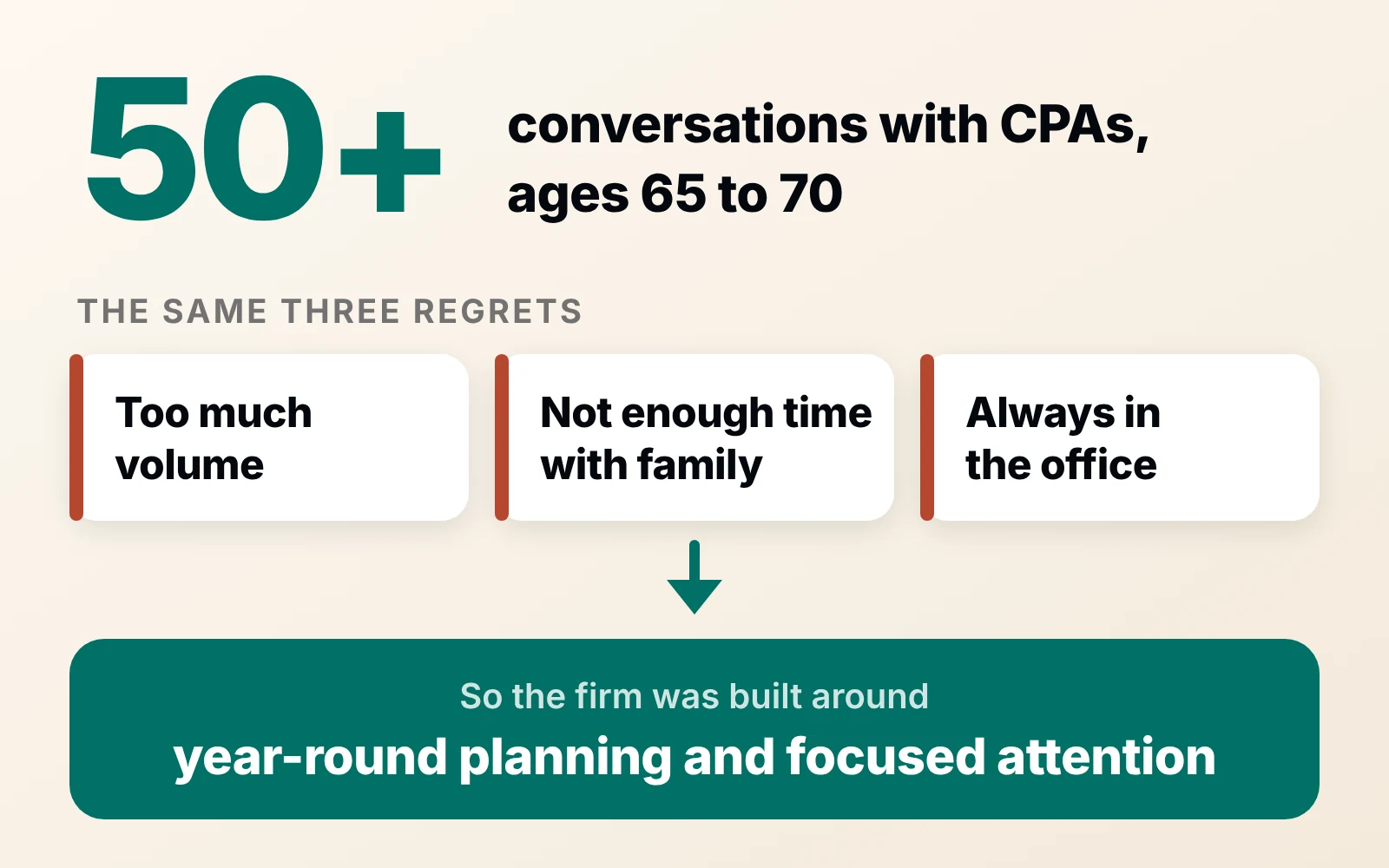
Richter Tax & Advisory was founded after conversations with more than 50 CPAs, ages 65 to 70, who shared the same regrets: too much volume, not enough time with family, always in the office. So the firm was built around year-round planning and focused attention instead of a few months of nonstop volume, which gives every client's work the attention it needs.
Ready to see if we're a fit?
Book a free, no-pressure 30-minute call. No commitment, just a conversation about your situation.
Book a Call Start the Work With Us Form